Experience of breeding the Grey-headed Bullfinch
ACCLIMATISATION AND HOUSING:
It was in October 1990 that I first encountered the grey-headed bullfinch. Whilst visiting an exhibition on a whim, my attention was drawn to a trader’s aviary, where there was a pair of grey-headed bullfinches that had recently been imported. Although my visit hadn’t particularly captivated me up to that point (there were too few birds native to Europe), time stood still and I must have spent nearly an hour observing these birds, which I had previously known only from J. GOULD’s colour plates or C. ARMANI’s notes.
Contrary to all expectations, I did not purchase them, as the two birds were not in good condition and were gorging themselves on oatmeal. Their plumage was coarse and dull, and I decided, somewhat reluctantly, to heed the voice of reason and not to buy them.
I was unaware at the time that the grey-headed bullfinch was to be imported on a massive scale throughout the winter for the first time in Europe.
It was sometime in November that a friend rang me to tell me he’d just bought two pairs of grey-headed bullfinches for me. The birds had just been imported and appeared to be in perfect condition. I was fortunate enough to have a pair of adults and a pair of young birds. The young male had not yet finished moulting and was not yet fully coloured. The bullfinches were housed in an outdoor aviary as November was not particularly cold. They were housed in pairs in aviaries 2.5 metres high, 2 metres deep and approximately 1 metre wide. The aviaries were lined with freshly cut branches of thuja and fir.The basic seed mix provided is the one I use for my colour-changing bullfinches and consists of canary seed, soft turnip seed, niger seed, linseed, hemp seed, sunflower seed, cardy, buckwheat, ‘health mix’, wild seeds, round millet, tree seeds, dried berries and grey perilla. I also provide millet on the stalk. The groats that formed the basis of their diet at the importer’s have been completely banned. Every day I check the feeders to see which seeds are being eaten. Their preference is for niger and hemp seeds; a few rapeseed seeds are touched, as well as a few ‘health mix’ seeds. Sunflower, cardy and buckwheat seeds are being shunned. The birds do not seem to have enough strength to crack this type of seed, which intrigues me greatly. After a few days, I realise that something is going on. The bullfinches’ plumage became coarse; some birds appeared to have cramps in their legs. A closer examination (handling them) revealed red bellies and traces of watery droppings. Based on my experience with European bullfinches, I diagnosed acute coccidiosis. The bullfinches were moved indoors (to a temperature of around 20 degrees), and were treated with a sulphonamide, administered alternately with a multivitamin complex. After a week, it turns out I made the right call, as the bullfinches have regained their strength and the males are beginning to sing.
As misfortunes never come singly, bringing them indoors to treat them more effectively has triggered a premature moult. The birds will not regain their magnificent plumage until late December. These various problems mean I cannot envisage the 1991 breeding season holding any prospect of successful breeding. So I am focusing my efforts on acclimatising the bullfinches. As the days go by, the basic diet provided is being accepted more and more readily. Cardy, sunflower and buckwheat seeds are regularly crushed, proof that the strength of their beaks is back to normal.
The grey-headed bullfinches are particularly calm and tame (more so than some of my European bullfinches, which have been domesticated for generations).
In early March, the two pairs were housed outdoors in the aviaries described earlier, and everything was going well. One morning, whilst I was feeding pyracantha berries to the various birds in my aviary, I heard hoarse calls similar to those made by the female European bullfinch during the breeding season. The grey-headed bullfinches had spotted the red pyracantha berries and were clinging to the wire mesh of their aviaries. Since that day, they’ve been given their weekly ration and make themselves heard if I forget them.
They now accept the same diet as European bullfinches and regularly enjoy white mealworm larvae, buffalo grubs and frozen pinckies. The season has begun and I am feeding them the same wild grasses as my other bullfinches.BREEDING
The grey-headed bullfinches’ aviaries are refurbished in early April. I place bundles of thuja wood and fresh fir branches inside. The bullfinches are busy extracting the seeds from the pine cones found on certain branches. Without really expecting much, I place some metal nests in the aviary to accustom the birds to this type of nesting box. Some old blackbird nests are also installed. I do not have any rhododendrons and would have liked to place a bush in the aviary (that will have to wait until 1992) – see note by C. ARMANI.
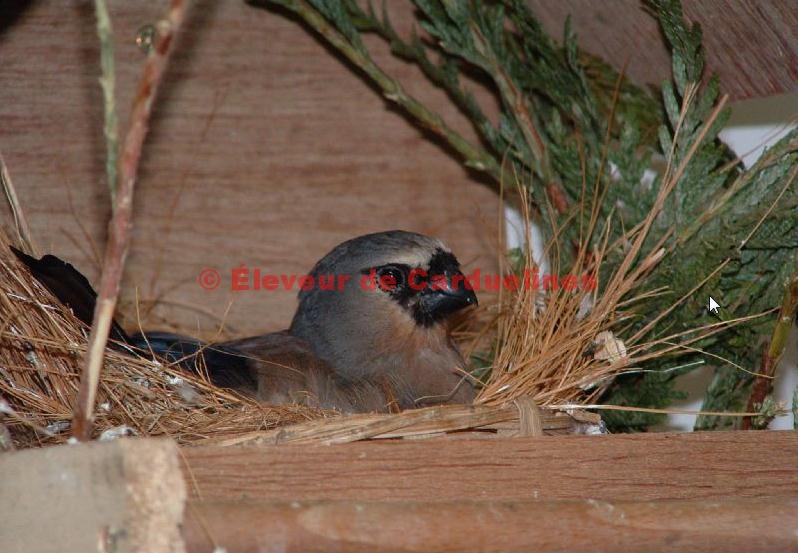
By the end of April, the pair of young bullfinches seem to be in increasingly good form. The male sings long, melancholic, flute-like verses, interspersed with squeaks and plaintive cries. The female approaches the male whilst he is singing at the tip of a branch; her behaviour is reminiscent of that of the peony bullfinch, as she opens her beak and lets out hoarse cries. The male remains unperturbed, then disappears into a thuja bush, only to reappear with a twig in his beak. Various building materials are then suspended in the aviary, namely: coconut fibres, horse and cowhair, rabbit fur, dried moss, cotton fibres and fine rootlets.A nest, 2 metres high, is finally built on a steel support, mainly using coconut fibres. The interior is lined with animal hair. The whole structure is rather crudely built. The first egg is laid on 25 April. The clutch will consist of three eggs, which will be white with brown spots. The grey-headed bullfinch’s egg can be compared to that of a European greenfinch: same colour, same size, same shape.
The female incubates the eggs alone whilst the male stands guard near the nest. I carry out several checks without the birds showing the slightest sign of distress. After 14 days, the female leaves the nest; to my disappointment, the eggs are pale, which seems understandable to me, given the false moults they went through during the winter. A week later, a new clutch is laid. The male sings constantly. The incubation period lasts around 14 days (the eggs are left with the parents and are not replaced). This time, luck is on my side, as the first grey-headed bullfinch chick has just hatched in my breeding programme. A magnificent little ball of down is wriggling about in the nest. The skin of the young grey-headed bullfinch is pinker and lighter in colour than that of a young European bullfinch. This will be the only chick to hatch, despite 100 per cent fertilisation. At 7 days old, the chick will be ringed with a 2.9 mm diameter ring.
Its diet consists of the basic mix, large quantities of wild grasses (sow thistles, shepherd’s purse, umbrella hawkweed, etc.), live insects (buffalo worms, mealworms, etc.) and small snails. A protein-rich feed is provided twice a day. On the 9th day, things became complicated as the male destroyed the nest and attempted to mate with the female, who was still brooding her chick. I therefore decided to place him under a female canary as a foster parent in order to protect him. Everything went smoothly and the pair went on to raise a new brood. It is worth noting that all three clutches were laid in the same nest, which was rebuilt each time by the female alone.
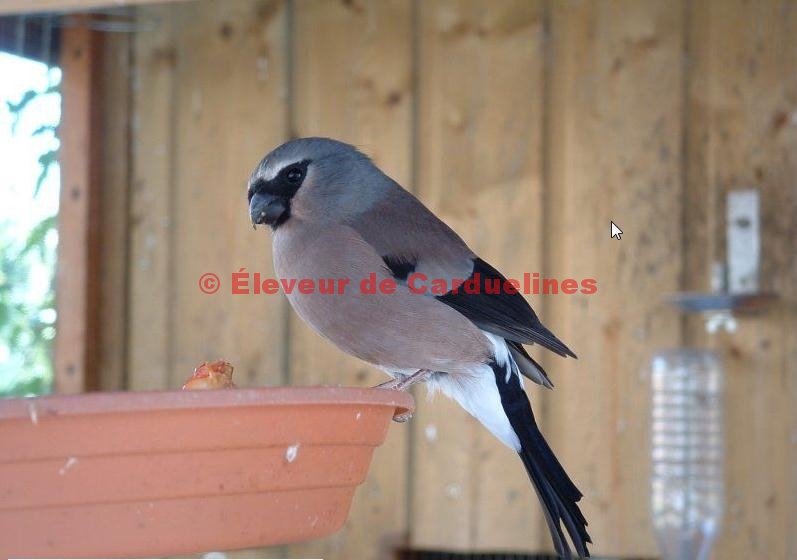
Whilst the chick is being very well looked after by the female canary (fed on pinckies), the third clutch hatches. Two of the three chicks hatch, but, with no foster mother available, they perish due to the male bullfinch becoming too agitated. At around 25 days old, the young bullfinch will venture outside the nest. It is only at two months old that it will be fully independent. I think it could have been independent much sooner, but to be on the safe side I preferred to leave it with its foster mother at all times.The young grey-headed bullfinch is predominantly brown, paler than a young European bullfinch with a normal phenotype, but already has a grey-black mask. This mask, which is already clearly defined, will turn glossy black after the juvenile moult. The immature bird’s beak is light in colour and gradually darkens to black. The tail already shows a gradient of colouration. The photo shows the young grey-headed bullfinch at 3 weeks old. Moulting begins between the 2nd and 3rd month. The young take on their colouring in their first year. The bird reared here is a superb male.
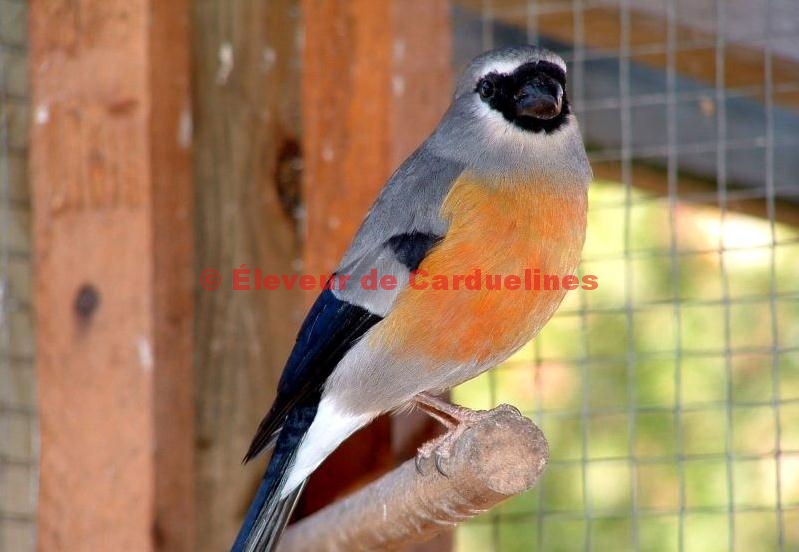
To avoid any risk of intestinal problems, I have decided not to colour the young grey-headed bird. It has a yellow-orange breast with greenish highlights, rather than an intense orange-red.
The parents are artificially coloured during moulting, but the males will not regain their original colour and will remain more orange in hue. It should be noted that after their artificial moult, the males had turned greenish-yellow, like the young bird described above, though less vivid. It seems that the same problems with natural colouration are encountered as with the linnet, the sizerin or the rosefinch.In my opinion, breeding the grey-headed bullfinch is no more difficult than breeding the common bullfinch. The main challenge lies in getting the breeding birds into condition and providing them with a rich and varied diet.
Jean-Michel Eytorff
Gallery