The Maltese Greenfinch, a Greenfinch with distinctive plumage bred through genetic selection!
Photos Copyright: Jean-Michel EYTORFF
Maltese Greenfinches: breeder Roderick ABELLA
THE MALTESE GREENFINCH, A POSTURED GREENFINCH OBTAINED THROUGH GENETIC SELECTION
Mutations in birds do not relate solely to colour. They can also be fixed and developed through selective breeding to influence size or shape. Through sheer perseverance, Maltese breeders have succeeded in producing a Greenfinch that no longer resembles its ancestral species found in the wild, the European Greenfinch (Chloris chloris). My Maltese friends were kind enough to send me the OMJ COM standard for the Greenfinch they have created, a domestic variety which I shall call the ‘posture Greenfinch’, comparable to certain posture canaries such as the Norwich or the Border. The rationale is that this form of greenfinch should be officially recognised as a domestic species in the regulations. With this in mind, together with UNICAB, the Naturalist Union for the Interests of Animal Conservation and Biodiversity, we have asked the Ministry to review the list of domestic species, which has remained unchanged since 2006.
I would add that to really get to know the Maltese Greenfinch, there is only one solution: to go and judge them in Malta! Thank you once again to our Maltese friends for sending us this document.
The photographs of Maltese Greenfinches were taken after they had been released from the aviary. When being prepared for shows, they gain 30 per cent in volume and are also much rounder.
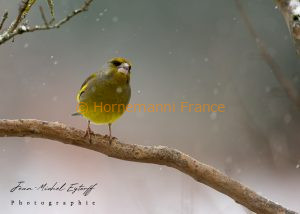
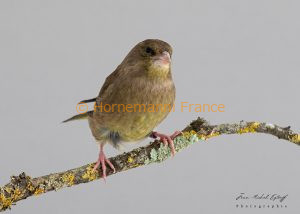
Male European Greenfinch (Chloris chloris)
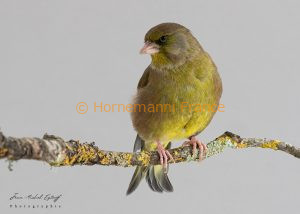
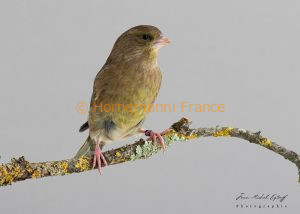
Male Maltese-bred Greenfinch (Chloris chloris)
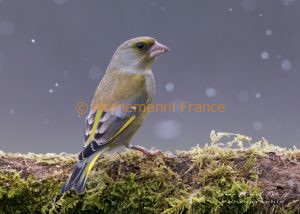
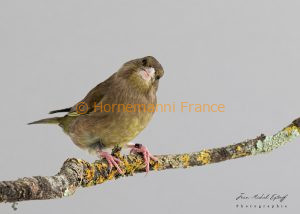
Male European Greenfinch (Chloris chloris)
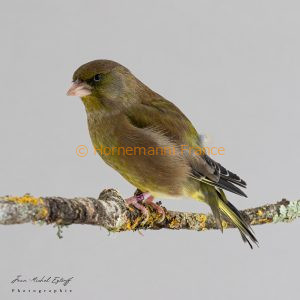
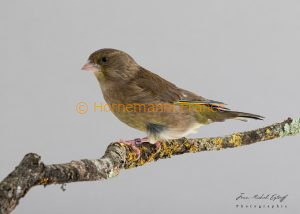
Male Maltese-bred Greenfinch (Chloris chloris)
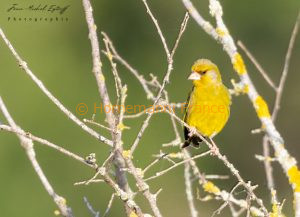
Male European Greenfinch, subspecies Chloris chloris aurantiiventris (found in southern Spain, southern Europe and Greece)
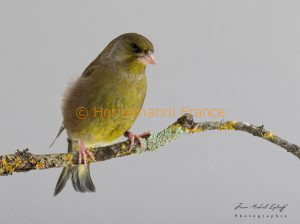
Male Maltese-bred Greenfinch (Chloris chloris)
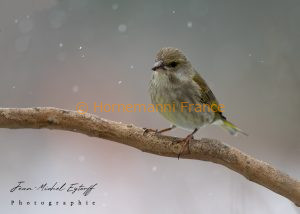
Female European Greenfinch (Chloris chloris)
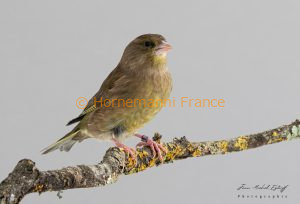
Female Maltese-bred Greenfinch (Chloris chloris)
Major Greenfinch
Show Standards
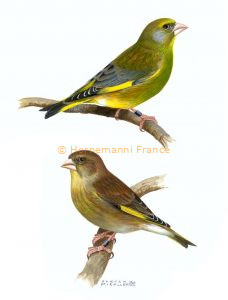
Size:
As large as possible, minimum 16.5 cm.
Type:
Beak;
The beak must complement the shape of the head.
Head;
A broad, well-rounded and high-set head, a clearly visible forehead, and a well-fleshed neck.
Body;
Viewed in profile, the bird must display a harmonious curve extending from below the throat to the lower abdomen. Similarly, a convex curve from the base of the neck to the rump is desired. It should stand upright on the perch at an angle of approximately 45°.
Thighs;
Not visible.
Wings;
Tucked close to the body, covering the upper tail coverts. Must not cross over or hang down.
Tail;
Relatively short, tight and distinctly forked.

Colours and Markings
MALES:
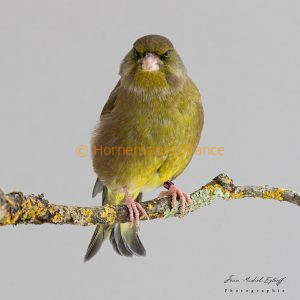
Bill;
Light flesh-coloured.
Eyes;
Dark brown.
Head;
A green forehead, with dark lores.
The supercilium is a lighter shade of green.
The crown and nape are greenish-brown.
The moustache must be darker and clearly visible. The ear patch is grey.
Back;
Greenish-brown with darker brown markings.
Rump;
Green, without contrast to the plumage.
The uppertail coverts should gradually change from olive-green to a greyish-brown.
Lower belly;
The throat and breast should be a rich, bright green, as clear and solid as possible, blending into the yellow of the belly, with the white of the lower belly kept to a minimum.
The yellow undertail coverts blend gradually into olive green.
Flanks;
Greenish brown.
Wings;
Primary flight feathers – must show rich yellow bars, forming a long mark on the lower edge of the folded wing.
The scapulars – brownish-green, blending with the mantle.
The secondary flight feathers – black with grey edges, wider and brownish on the tertials.
The small upper-wing feathers – green.
Medium supralares – olive green.
Primary coverts – a brownish grey.
Alula – bright yellow.
Tail:
Black with bright yellow spots and a grey outer fringe.
The central tail feathers are black with a green edge.
Legs and toes;
Flesh-coloured.
Claws;
Dark flesh-coloured.
FEMALES:
Type;
As for the male
Colour;
Bright brownish and greenish hues. The yellow on the wings and tail will not be as extensive as in the male.
Bill;
As for the male
Eyes;
As for the male
Head;
The forehead is brown with a greenish tinge.
The supercilium is paler.
The crown and nape are brown with darker markings.
The moustache, a darker brown, must be clearly visible.
The ear patch is grey.
Back;
Brown with darker markings. The markings on the back must be aligned, tapering towards the head and extending to the rump.
Rump;
Green, with the supracaudals olive-green verging on brown.
Lower abdomen;
The throat is greyish-brown with a green tinge.
The breast should be light brown with a green tinge and darker markings.
The markings on the breast are broader and less distinct.
The belly is green, fading to white around the lower abdomen.
The undertail coverts are grey with a slight brown tinge.
Flanks;
Brown
Wings;
Scapulars – brown.
Primary flight feathers – blackish brown. A yellow edge, thinner and less vivid than in the male.
Secondary flight feathers – blackish brown with greyish-brown edges.
Small upper-wing coverts – olive green.
Medium upper-wing coverts – olive green to brown.
Primary coverts – black with a green edge.
The alula – blackish-brown with a yellow edge.
The tail;
Black with a yellow outer edge. The central tail feathers are blackish-brown.
Legs and toes;
Flesh-coloured.
Claws;
Dark flesh-coloured.
NOTE
Note on Size:
Although larger specimens are preferred, size should not compromise the quality of colour and form.
Whilst the standard encourages the largest possible size, selection for this may result in numerous faults: poor plumage, reduced fertility and weakened immunity. No fancier should consider perpetuating such faults by breeding birds with these traits.
Note on Type:
The head should not be angular or ‘box-shaped’. The forehead must be well defined, with a good rise from the upper mandible, resulting in a well-defined forehead. The skull should be broad at the top and towards the neck.
The body must be compact and round, giving a robust and rounded appearance.
Note on Colours and Markings:
MALES:
Brownish tints on the head, back and flanks shall not be considered faults, but a bird displaying a brighter green shall be regarded as superior.
Schimmel birds display less colour than intensives. It is therefore less easy for a schimmel to win against the best intensives, although schimmels may win on the strength of their superiority in type and size.
Note on Colours and Markings:
FEMALES
The white around the lower abdomen is more extensive than in males, often extending across the belly.
Brightly yellow females will display plenty of colour on the breast and this, combined with good performance in terms of size and type, should lead to success. Schimmel females will often perform better than yellow ones in their class but will be beaten by a yellow cock when competing for Best Greenfinch.
General notes:
The bird must display a certain pride and stand firmly on its perch, gazing intently at the audience.
Should the intensive and schimmel varieties be judged to be of equal merit, the yellow takes precedence. However, if the schimmel, whilst already well-coloured, is superior in terms of type, it takes precedence.
FAULTS
Faults of Type:
A narrow skull. Poorly placed eyes. A beak that is too large or too small.
Above all, avoid a bird that appears to form a straight line from the top of the head to the tail—a shape likened to a ‘ski run’, where the bird is ‘long’. This straight line can never produce the rounded shape sought in this bird. Worse still: a hollow back.
Deformities, a pear-shaped bird, excess weight on the breast or lower abdomen, resulting in poor posture. The bird should not be lying down or crouching on the perch.
Poor wing carriage.
Colour and marking faults:
MALES
Colour impurities: discolouration or an excessive presence of grey, giving an overly dark appearance.
The presence of brown on the breast and belly.
FEMALES
Excessive white, giving the impression of a pale bird.
General faults:
A bird that appears weak, not standing upright, lacking confidence.
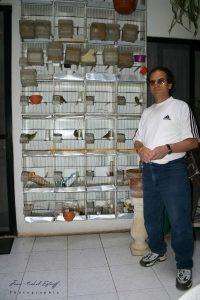
It was in 2005, at the World Championship in Bad Salzuflen, that I had the chance to discover and judge my first Maltese Greenfinches. That was all it took to make me want to meet Jimmy Zammit Fava, the Maltese breeder whose birds had won medals. I’ll remember the welcome I received at his home for the rest of my life, and my discovery of this postural Greenfinch, of Scottish origin, which, through selective breeding, had already become a particularly impressive bird in terms of size and stature, thanks to this breeder’s passion
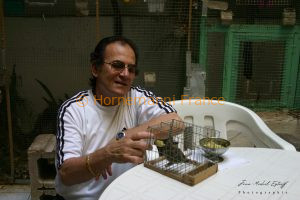
Feeding time for a Maltese greenfinch during my visit.
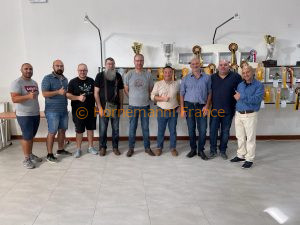
It was not until much later that I had the chance to judge twice in Malta at the Malta Song Bird Association show. A friendship was forged through these encounters. A particularly dynamic club of fanciers that shines every year at the COM World Championships. Birds of a standard rarely, if ever, seen in France.
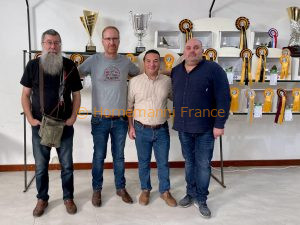
A memento of our last judging assignment in 2022. Three French judges from the section, judging this magnificent show, surround Roderick, the show’s best competitor. From left to right: Jean-Luc, yours truly, Roderick, and David.
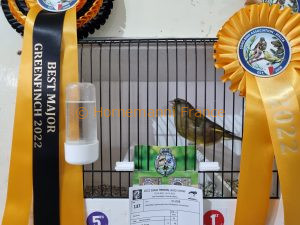
Best Male Maltese Greenfinch – Best in Show!