
Breeding of the Bearded Reedling (Panurus biarmicus)
Description
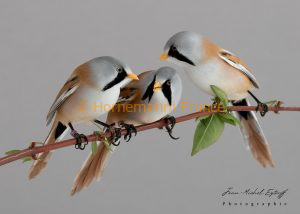
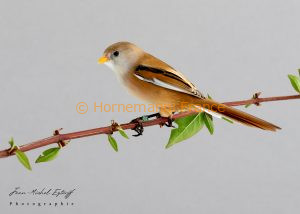
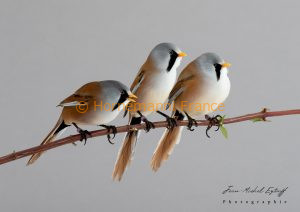
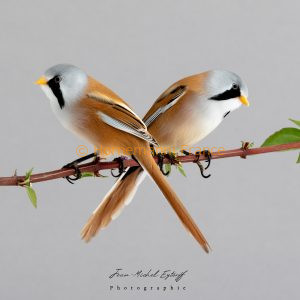
The photos speak for themselves. The male has a distinctive head pattern with two black stripes, which give the species its name, the moustached warbler. The female does not have this feature.
Distribution and Habitat
Moustached Finches live in large reed beds and near ponds. In France, they are found mainly along the coast.
Regulatory status
– Protected species. All wild-type individuals are considered protected. There are no recognised domestic mutations for this species.
-Holders must hold a certificate of competence for quota 1.
-Keeping even a single specimen requires compliance with current regulations
-Holders must have authorisation to operate a breeding establishment for quota 1
-IFAP registration
-Animals kept must be identified using a closed ring suitable for the diameter of the species or subspecies.
-Transfer only between licence holders with a marking certificate (CERFA)
OMJ Standard
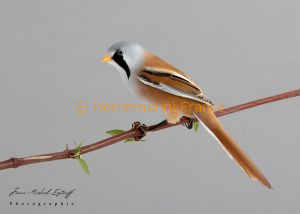
: Body size: 16/17 cm.
Round, stocky head; rounded body; long, tapered tail
Head hooded in bright grey
On either side of the beak, vertical black markings in the shape of whiskers, encircling the eye and tapering to a point at the base of the throat.
White chin and throat
Nape and sides of the neck grey like the head, clearly demarcated from the russet-brown colour of the back
Back: Rust-brown, clearly demarcated by a white line running from the shoulder along the contour of the wing.
Chest and throat: Throat, breast and underparts white down to the anal region
Flanks: Chamois-brown, widening towards the belly and lower part
Belly, anal region: Reddish-white
Wings: Reddish-brown coverts; the folds near the wing are marked with black.
The first four primary flight feathers are white, with faint black markings at the base and tip.
The other flight feathers are russet-brown; those closest to the back are partly black, forming a black line that runs alongside the white line on the back
Rump Blackish-brown
Tail: Reddish-brown tail feathers; the outer tail feathers are fringed with black.
Beak: Yellow, fairly curved, slender and pointed
Eyes: Yellow eye ring; black centre
Legs and toes: Black
Claws: Black
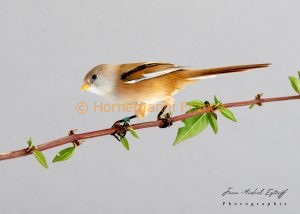
Notes: The female has a plain, cream-beige head pattern and greyish-cream cheeks; the rest of the plumage is identical to that of the male, though the colours are duller and there may be blackish markings on the head and lower back.
Breeding conditions:
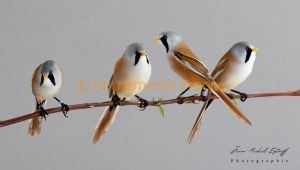
The pair is placed in a small aviary measuring 1m x 2m x 1m from winter onwards. Larger, planted enclosures may also be used, provided no other tit species are kept in the aviary.
In an indoor aviary, I use bamboo branches and reeds to furnish the breeding area. Teardrop-shaped wicker nests are concealed amongst them. In the wild, they weave a nest in the reeds.
Nesting materials:
Coconut fibre, cotton, horsehair, goat’s hair, feathers.
Breeding behaviour:
The pair are very close. Both parents take turns incubating the eggs. The clutch consists of an average of 5 eggs.
Dry food
: I use two types of pellet mix. One for Japanese nightingales, and one enriched with dehydrated insects for birds with fine beaks. Versele Laga’s NutriBird Uni Komplet maintenance extruded pellets for small fruit-eaters and insectivores are always available to the birds.
Supplier’s description: -
suitable for small fruit-eating, nectar-feeding and insectivorous birds
- complete and balanced diet
- pellets with a scientifically formulated composition, based on selected seeds and plenty of fresh fruit
- completely consumable, no waste
- contains Florastimul: stimulates gut flora and protects against digestive problems
- promotes a beautiful plumage
- optimal calcium-to-phosphorus ratio for bone health
I also provide a mix for budgerigars and red and russet millet.
Live or frozen food
During the winter, I provide mini mealworms or live buffalo worms. Whilst the chicks are being fed, the parents are given live insects three times a day. Thawed pinckies are used, but are not as popular. Some females spend their time searching for insects in the aviary, a sign that the diet is not suitable for rearing. Generally, when this behaviour is observed, the brood is a failure.
Ringing the young
This is a tricky task as the nest is not always accessible. Rings measure 2.5 to 2.7 mm. However, sometimes one has to resign oneself to ringing the birds once they have left the nest.
Weaning the chicks
Between the 15th and 20th day after hatching, the chicks leave the nest. They stay close by and are often huddled together on a branch. The chicks can be sexed as soon as they leave the nest. Males have a yellow beak and females a greyish one. The young will be independent after a month. During weaning, the amount of animal feed is reduced in favour of insectivorous mash.
Juveniles have predominantly beige-brown plumage. Males do not have a moustache.
Showing
These birds are not difficult to show. You simply need to get them used to the show cage. When I judge this species at a competition, whether it’s an international or a world show, this species is very often among the contenders for the top prize.
Jean-Michel EYTORFF