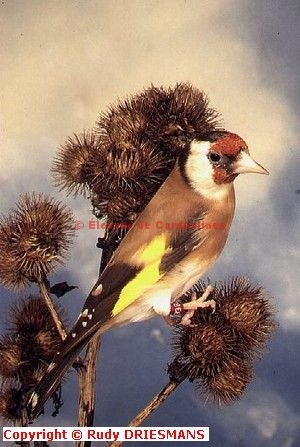
Elegant Goldfinch – Brown
Description:
Photo by Rudy DRIESMANS
Like the pastel and agate colour forms, the brown factor is sex-linked and recessive. The Brown Goldfinch is remarkable in that the black eumelanin is replaced by brown pheomelanin. As a result, as with the brown-mutated Siskin, the black colouring in the bird has turned dark brown. The back is a much warmer brown than in the wild form, whilst the mask is paler due to the transformation of the black. The crown is slightly lighter in the female, but remains dark brown. This mutation, combined with the Agate mutation, produces remarkable goldfinches with the Isabelle mutation. Indeed, when an agate male is mated with a brown female, the offspring include agate females, but above all double-carrier males known as ‘passe-partout’. The process of crossing-over (chromosomal crossover) triggers the emergence of the Isabelle mutation (a phenomenon previously observed in the European Greenfinch, the Sizerin, the Siskin and the Canary).
It is, however, worth noting that creating a strain of mutated goldfinches requires years of patience and dedication, as this is a particularly difficult Carduelinae species to breed when it exhibits plumage variation (and also in its wild phenotype). For example, in the Pastel, there is a high degree of fragility in both the embryo and the chick at hatching. It is, in fact, not uncommon to observe mortality amongst young mutants whilst still in the egg (around the sixth day, or on the eve of hatching) and also during the first two days of life.
Once these stages have been successfully navigated, the next challenge is to ensure that the yearlings come through moulting and the winter period unscathed. Damp winters are particularly difficult to get through safely (due to coccidiosis!). These problems generally subside in the second year, as the birds’ resistance increases with age.
Gallery